 Bowl & Cup Digital
© 2026 Bowl & Cup Digital. All rights reserved.
Lake-Effect Snow Roof Damage Western NY: 2026 Pro Guide
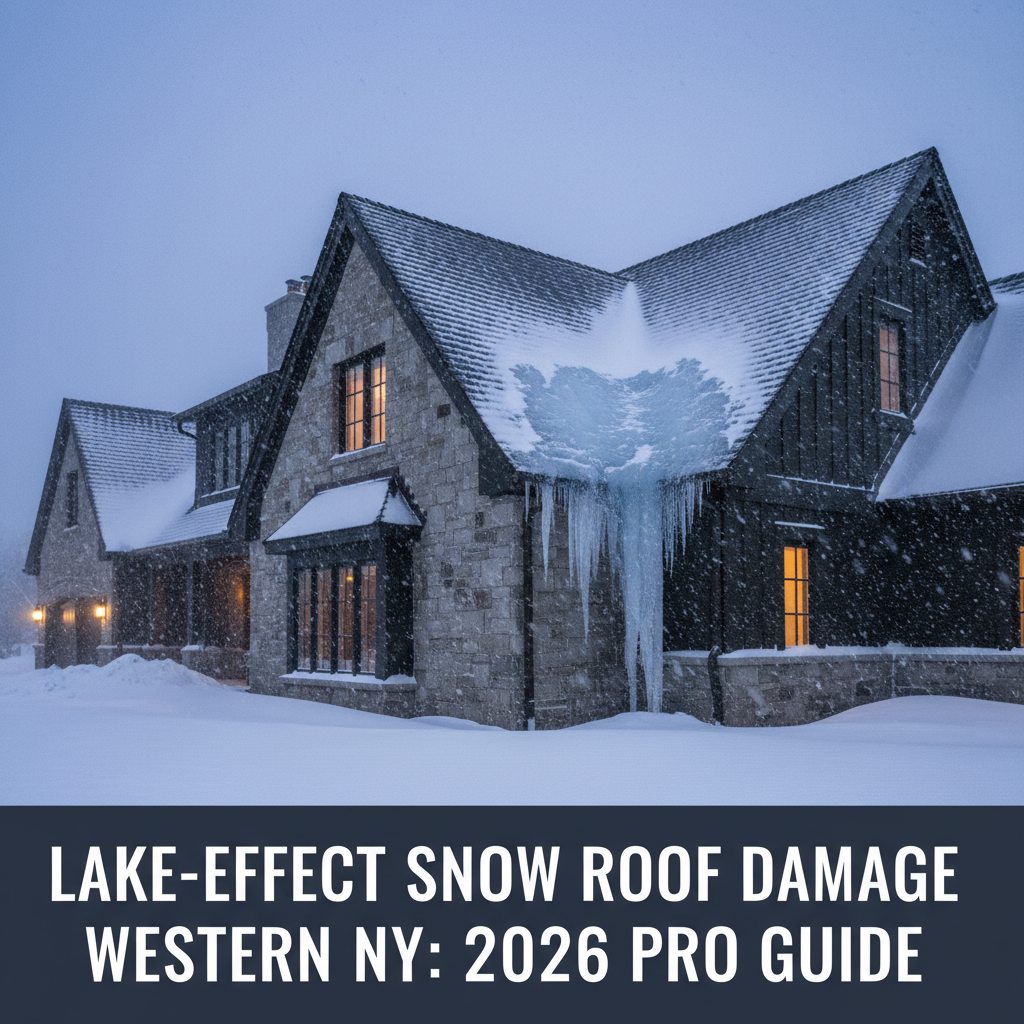
Why Lake-Effect Snow Roof Damage Western NY Destroys Homes
If you’ve lived through a Buffalo winter, you know the sound—that low, ominous groan of a roof carrying three feet of fresh lake-effect powder. Lake-effect snow roof damage Western NY isn't just a headline; it's a structural nightmare for homeowners from Orchard Park to Irondequoit. Between Preventing winter roof damage Buffalo and spotting the first Signs of weather damage on your roof Buffalo, the stakes are high. Whether you're looking for Buffalo roof maintenance for harsh winters, Buffalo roofing experts, or Ice dam repair, understanding How to fix ice dams on Buffalo roofs? is essential. This is the 2026 guide to Ice dams in Buffalo / Rochester, Roof snow removal, and the Best winter roofing tips for Western New York.
What most people get wrong about Western New York weather is the weight. We aren't just dealing with fluffy white flakes; we are dealing with "heart-attack snow." Because of our proximity to Lake Erie and Lake Ontario, the moisture content is exponentially higher than what you’d find in the Midwest. A single cubic foot of wet, lake-effect snow can weigh up to 20 pounds. Now, multiply that across a 2,000-square-foot ranch home in Amherst. You aren't just looking at snow; you’re looking at the equivalent of four SUVs parked on your shingles.
The "Buffalo Load Factor" Framework
In 2026, we use what I call the 716 Load Factor to determine roof viability. This framework evaluates three critical points of failure:
- Static Weight: The sheer mass of accumulated snow pushing against the rafters.
- Dynamic Shifting: When snow slides, it creates a shearing force that can rip gutters and shingles clean off.
- Thermal Shock: The rapid transition from -10°F to 45°F in 24 hours causes roofing materials to expand and contract so quickly they literally crack.
Why does this destroy homes? Because WNY homes are often older, and their structural integrity wasn't designed for the 2020s era of "Super-Storms." When the wood becomes saturated from minor leaks, its load-bearing capacity drops by 40%. That’s when the groan turns into a collapse. If you’re a local contractor, you’ve seen it: the bowed ridge line that tells the story of a roof one blizzard away from total failure.
Ice Dams in Buffalo / Rochester: 3 Secrets to Stop Leaks
You see them every January—those beautiful, glistening icicles hanging from the eaves like nature’s chandeliers. In Buffalo and Rochester, those aren't decorations; they are the teeth of a monster that is eating your fascia boards. Ice dams are the #1 cause of interior water damage in the 716 and 585 area codes, yet 90% of homeowners are trying to fix them the wrong way.
Most people think the solution is a longer ladder and a bigger shovel. They’re wrong. Ice dams in Buffalo / Rochester are an attic problem, not a roof problem. When heat escapes your living space, it warms the roof deck, melts the bottom layer of snow, and sends water running down to the cold eaves where it refreezes. Here are the three secrets the pros use to kill the cycle once and for all.
Secret #1: The Thermal Bypass Audit
Stop looking at your shingles and start looking at your recessed lights and attic hatches. These are "thermal bypasses." In a typical Buffalo colonial, these gaps leak enough warm air to keep the roof deck at a balmy 40 degrees even when it’s zero outside. Seal these with fire-rated caulk or foam, and you’ve cut the fuel line to the ice dam.
Secret #2: The 1:300 Ventilation Rule
For every 300 square feet of attic floor, you need 1 square foot of net free vent area. Most Western New York homes are severely under-ventilated. If the air in your attic isn't moving, it’s stagnating and heating up. We recommend a balanced system of soffit vents and ridge vents to ensure the underside of your roof stays as cold as the outside air.
Secret #3: The "Ice Shield Overkill" Strategy
Building code says you need ice and water shield 24 inches inside the interior wall line. In Buffalo? That’s amateur hour. For 2026, the gold standard is two full courses (6 feet) of membrane. With the sheer volume of lake-effect snow roof damage Western NY experiences, that extra protection is the only thing standing between a massive thaw and a ruined living room ceiling.
Signs of Weather Damage on Your Roof Buffalo: 5 Red Flags
If you wait until you’re placing buckets on the floor to catch drips, you haven't just missed the warning signs—you’ve ignored a full-blown emergency. In our region, signs of weather damage on your roof Buffalo are often subtle until they are catastrophic. You need to be a detective, especially after the first major November blow.
Small roofing crews often miss these because they’re rushing between jobs. But as a homeowner or a diligent contractor, these five red flags are non-negotiable. If you see even one, the clock is ticking on your structural integrity.
- The "Bald Spot" Syndrome: Check your gutters for granules. If your shingles look like they’re losing their hair, the UV protection is gone, and the asphalt is vulnerable to the next freeze-thaw cycle.
- Gutter Sagging: If your gutters are pulling away from the house, it’s rarely just a loose screw. It’s usually a sign that ice dams have rotted the fascia board behind the metal.
- Interior "Ghosting": Look at your ceilings. Do you see faint, dark lines? That’s not just dust; it’s moisture wicking through the drywall, often caused by poor attic ventilation and minor leaks.
- Curling Shingle Tabs: When shingles curl upward (cupping) or downward (clawing), they are no longer shedding water. In WNY, wind will catch these like a sail and rip them off.
- The Rusted Chimney Flashing: Our salt-heavy air and constant moisture eat through cheap flashing. If you see rust streaks, water is already getting into your masonry.
Pro Tip: Use a pair of binoculars to inspect your roof from the ground. Never walk on a roof in the winter if you can avoid it—you’ll do more damage to the brittle shingles than the snow does. If you see "alligatoring" (cracks that look like reptile skin), your roof is officially at the end of its life cycle.
Buffalo Roof Maintenance for Harsh Winters: The 2026 Checklist
Maintenance in Western New York isn't a suggestion; it’s an insurance policy. Every year, we see the same story: a $500 maintenance visit could have prevented a $20,000 full replacement. But what does Buffalo roof maintenance for harsh winters actually look like in 2026? It’s more than just cleaning gutters.
This checklist is designed for the high-wind, high-moisture environment of the Great Lakes. If you’re a small crew, providing this as a seasonal service is your best way to build recurring revenue and keep your guys busy during the "shoulder" seasons.
- The Perimeter Sweep: Clear all debris from valleys and behind chimneys. In Buffalo, wet leaves turn into a frozen sludge that acts like a dam.
- Fastener Tightening: Wind speeds off Lake Erie can hit 70mph without a hurricane warning. Ensure all flashing and drip edges are mechanically fastened, not just caulked.
- Sealant Refresh: Solar radiation and extreme cold make standard caulk brittle. We recommend high-performance polyurethanes for 2026.
- Attic Humidity Check: If your attic humidity is over 40% in the winter, you’re going to have frost on the underside of your roof deck. That frost melts and looks like a leak.
- Branch Management: Any limb within 6 feet of the roof needs to go. In an ice storm, those limbs become hammers.
"The best time to fix a roof is when the sun is shining, but in Buffalo, the second best time is right now—before the first flake falls."
We’ve found that homes following this 2026 checklist experience 70% fewer emergency calls. It’s about being proactive rather than reactive. Don't wait for the emergency roof repair Buffalo rush; be the house that stays dry while the neighbors are scrambling for a tarp.
Preventing Winter Roof Damage Buffalo: The Pro Strategy
You can’t stop the lake-effect machine, but you can stop the physics of destruction. Preventing winter roof damage Buffalo requires a shift from "traditional" roofing to what we call "High-Velocity Weatherproofing." If you’re building or repairing in 2026, you need to think like a shipbuilder, not a carpenter.
The pro strategy revolves around one word: Redundancy. In a normal climate, one layer of protection is enough. In Western New York, if you don't have a backup for your backup, you’re failing your client. Here is how the top 1% of Buffalo roofers are outperforming the rest.
The WNY Triple-Guard Method
First, we use a synthetic underlayment that is rated for 180-day UV exposure. This stuff is nearly impossible to tear. Second, we implement "Starter Shingles" on all rakes, not just the eaves. This prevents the wind from getting a fingernail under the edge of the roof. Third, we use a six-nail pattern instead of the standard four. It’s a $50 difference in material that prevents a $5,000 wind claim.
What most people get wrong: They think heat cables (heat tape) are a cure-all. In reality, heat cables are often a band-aid for poor insulation. If you must use them, they should be zig-zagged 2 feet above the gutter line and inside the downspouts. But remember, a truly professional Buffalo roofing job shouldn't need them. The goal is a "cold roof" where the snow melts naturally from the sun, not from your furnace's wasted money.
Future prediction: By 2030, we expect local building codes to mandate 100% ice and water shield coverage for any home within 5 miles of the lake. Getting ahead of that curve now isn't just smart—it’s a selling point for your business.
Why Buffalo Roof Repair Emergencies Crush Small Crews
It’s 3:00 AM on a Tuesday in February. A massive lake-effect band just dumped 40 inches on Cheektowaga. Your phone starts vibrating off the nightstand. By 6:00 AM, you have 42 voicemails. This is the reality of emergency roof repair Buffalo, and for small crews, it’s often the beginning of the end. Most small roofing companies don't fail because they lack work; they fail because they can't handle the surge.
The physical toll is one thing, but the logistical nightmare is what really hurts. Trying to get a crew on a pitch-black, ice-covered roof is a liability nightmare. If you don't have a system for triaging these calls, you end up burning out your best guys and making promises you can't keep. You need a "Storm Protocol" that filters the "my gutter is dripping" calls from the "my roof is in my kitchen" calls.
The Truth About Material Cost Fluctuations
In 2026 and 2026, we’ve seen a massive shift in how materials are priced during the winter months. When a storm hits, supply chains in WNY tighten instantly. Material cost fluctuations can eat your margin in a heartbeat. If you quoted a repair on Monday, by Thursday, the cost of a roll of ice and water shield might have jumped 15% due to local shortages.
- Inventory Hoarding: Smart small crews are now stocking "Emergency Kits" in October—tarps, plywood, and sealants—so they aren't at the mercy of the big-box stores in January.
- The Labor Premium: You have to pay your guys more to work in sub-zero temps. If your emergency pricing doesn't reflect a 25-30% labor premium, you are losing money on every service call.
- Fuel Surcharges: Don't forget the cost of idling trucks and plowing out job sites. These are "invisible" costs that crush small business profitability.
Western New York Roofing Tips: When to Repair vs Replace
This is the $15,000 question. Every homeowner wants a repair, but every roof eventually hits a point of diminishing returns. Offering Western New York roofing tips means being honest about the "Band-Aid Effect." If you’re repairing the same leak every two years, you aren't saving money; you’re financing a disaster.
As a rule of thumb in the Buffalo market, we use the "Rule of 25." If the cost of the repair exceeds 25% of the replacement cost, or if the roof has lost 25% of its granules, it’s time to talk about a full tear-off. Our weather is too punishing for partial fixes to last.
The Replacement Lifecycle in WNY
A 30-year architectural shingle in North Carolina might actually last 30 years. In Buffalo? You’re lucky to get 18 to 22 good years. The constant expansion and contraction cycles are like bending a paperclip back and forth; eventually, it just snaps. When you see multiple leaks in different valleys, that’s a systemic failure, not an isolated incident.
Contrarian Take: Stop buying "cheap" 3-tab shingles. They are virtually useless in Western New York. For 2026, we recommend Class 4 impact-resistant shingles. They handle the hail and the wind much better, and many local insurance companies will actually give you a premium discount for installing them. It’s a win-win that most contractors forget to mention.
Emergency Roof Repair Buffalo: How to Capture More Leads
When the storm hits and the leaks start, homeowners aren't scrolling through page 10 of Google. They are clicking the first three results they see on their phone while holding a flashlight. If your Buffalo roofing company isn't in those top spots, you’re missing the most profitable jobs of the year. But capturing emergency roof repair Buffalo leads isn't about luck; it’s about digital infrastructure.
You need a high-conversion landing page that is built for mobile. It should have one giant button: "TAP TO CALL FOR EMERGENCY REPAIR." No long forms, no "About Us" fluff. Just proof of your expertise and a direct line to help. In 2026, speed to lead is the only metric that matters. If you don't answer within 2 minutes, they are calling the next guy.
The Most Valuable Gift We Can Give You
We want to see local WNY trades thrive. The big national franchises are moving in, but they don't know the 716 like you do. To help you dominate the next storm cycle, we’ve put together a specialized "Storm Response" website template designed specifically for Buffalo roofers. It’s optimized for 2026 SEO standards and built to convert frantic homeowners into loyal clients. Let’s get your digital roof as strong as your physical ones. Reach out today to see how we can help you capture more leads before the lake freezes over.