 Bowl & Cup Digital
© 2026 Bowl & Cup Digital. All rights reserved.
Roofing Buffalo: 5 Critical Challenges Facing WNY Pros
Roofing Buffalo: 5 Critical Challenges Roofers Face Today
If you live in Western New York, you don’t just have a roof; you have a frontline defense system against some of the most volatile weather on the planet. Whether you are searching for Roofing Buffalo solutions or trying to understand the unique challenges roofers face in our region, the stakes couldn't be higher. In 2026, Roofing Western New York is no longer just about nailing shingles; it is about engineering a structure that survives 7-foot snow dumps and 60-mph gusts off Lake Erie. As top-tier Roofing contractors WNY, we see homeowners constantly asking: What are the biggest roofing challenges in Buffalo NY? and What are the best roofing materials for Western New York lake effect snow? The reality is that NY roofing costs are shifting, and Buffalo roofing requires a level of expertise that out-of-towners simply can't replicate. This guide breaks down the hard truths of protecting your home in the 716.
- Climate Extremes: Why our weather is a roof's worst nightmare.
- Economic Volatility: The hidden factors driving up your quote.
- Contractor Integrity: How to spot the difference between a craftsman and a salesman.
In this deep dive, we’re pulling back the curtain on the industry to show you exactly what happens on your roof when the sky turns grey and why your choice of contractor determines if your home stays dry for 30 years or fails in five.
Roofing Buffalo: Why Lake-Effect Snow Ruins Local Roofs
Imagine placing a full-sized SUV on top of your house and leaving it there for three months—that is essentially what lake-effect snow does to a standard residential structure in Buffalo. While most national building codes account for "average" snow loads, Roofing Buffalo experts know that there is nothing average about a lake-effect band that stalls over Orchard Park or Amherst. The sheer weight of saturated snow can exceed 20 to 30 pounds per square foot, leading to structural deflection that most homeowners never notice until their interior drywall starts to crack.
The Physics of the "Heavy White Blanket"
When lake-effect snow hits, it isn't the light, fluffy powder you see in the Rockies. It’s dense, moisture-laden, and prone to "loading" on the leeward side of your roof. This uneven distribution creates massive stress on your rafters and ridge beams. At our firm, we utilize the Buffalo Snow Load Framework (BSLF), a proprietary calculation that accounts for secondary moisture absorption. We’ve found that a roof’s structural integrity often degrades by 12% faster in WNY compared to inland upstate regions simply due to this consistent weight pressure.
- Structural Creep: Over time, the weight of repetitive heavy snowfalls causes wood members to permanently deform.
- Ventilation Blockage: Deep snow covers ridge vents, suffocating your attic and leading to moisture buildup.
- Shingle Scouring: As snow slides off steep pitches, the ice crystals act like sandpaper, stripping the protective granules off your shingles.
What most people get wrong is thinking that a "stronger" shingle is the solution. In reality, the solution is a combination of reinforced decking, high-temperature ice and water shields, and a ventilation system that can breathe even when buried under three feet of the white stuff. If your roofer isn't talking about static load-bearing capacity, they aren't a Buffalo roofer.
Roofing Western New York: Surviving the Freeze-Thaw Cycle
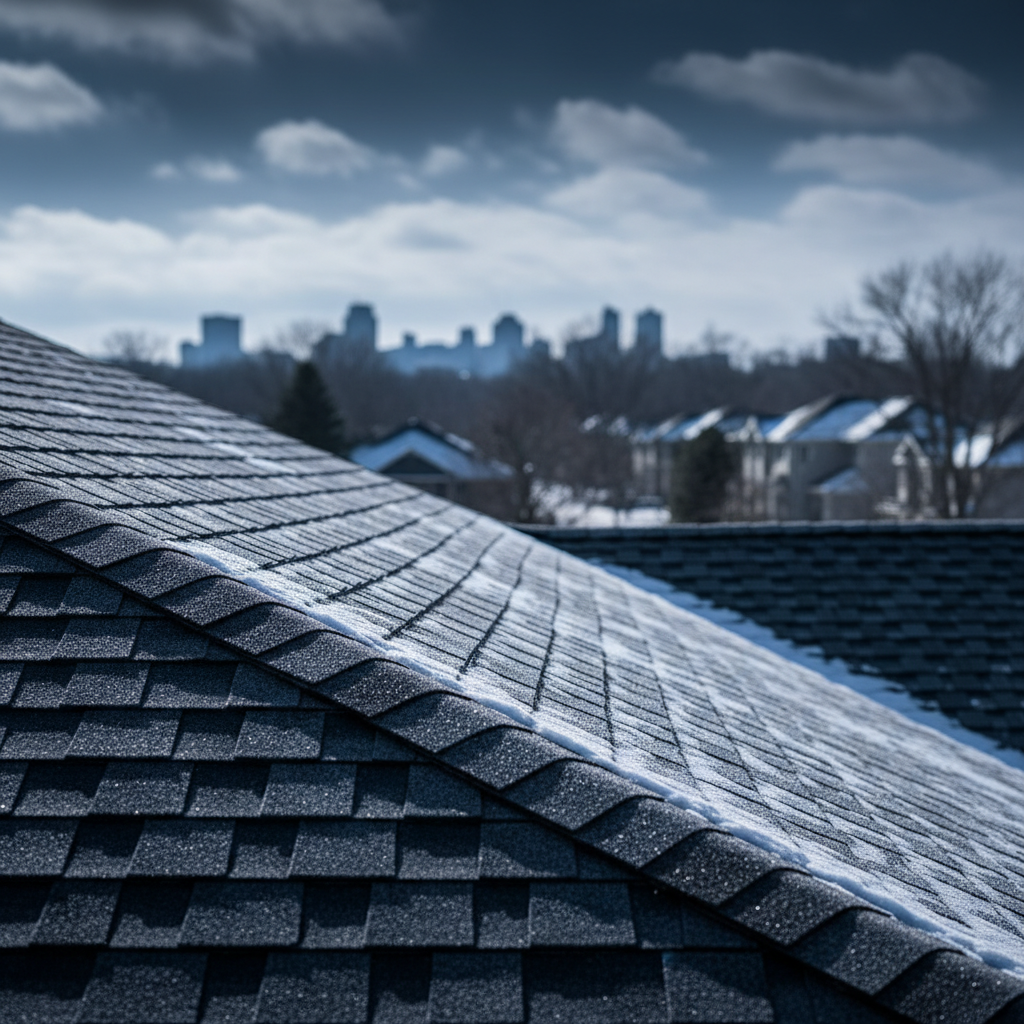
If lake-effect snow is the heavy hammer, the freeze-thaw cycle is the slow-moving chisel that picks your roof apart piece by piece. In Roofing Western New York, we experience a phenomenon where temperatures can swing 40 degrees in a single 24-hour period. This constant expansion and contraction is the primary reason why roofs in Buffalo age twice as fast as those in milder climates. When water gets into a tiny crack during a 45-degree afternoon and freezes at 20 degrees that night, it expands with enough force to crack stone—your shingles don't stand a chance without the right protection.
The Anatomy of an Ice Dam
The freeze-thaw cycle is the biological father of the dreaded ice dam. Heat escaping from your attic melts the bottom layer of snow on your roof. That water runs down to the cold eaves, where it refreezes, creating a literal dam of ice. As more water pools behind it, it finds its way under your shingles, through your plywood, and eventually, into your living room ceiling.
"An ice dam isn't a roofing problem; it's a physics problem caused by poor insulation and ventilation."
The 3-Step Defense Against Freeze-Thaw Damage
- Enhanced Underlayment: We mandate a double-width application of self-adhering ice and water shield—far exceeding the standard NY building code.
- Attic R-Value Optimization: By keeping the roof deck cold, we prevent the initial melt that starts the cycle.
- Balanced Ventilation: Ensuring that intake (soffit) and exhaust (ridge) airflows are perfectly matched to flush out heat.
Don't be fooled by contractors who suggest "heat cables" as a primary solution. Those are merely a bandage on a broken arm. True resilience comes from a roofing system designed to handle the thermal shock of a Buffalo winter without cracking, buckling, or leaking.
3 Mistakes Homeowners Make Hiring Buffalo Roofing Crews
After a decade in the trenches of the WNY construction scene, I’ve seen homeowners lose tens of thousands of dollars by falling for the same three traps. The challenges roofers face are often exacerbated by homeowners who prioritize the wrong metrics during the hiring process. If you want to avoid a nightmare scenario, you need to look past the shiny truck and the low-ball estimate.
Mistake #1: The "Lowest Bid" Fallacy
In Buffalo, if a quote looks too good to be true, it’s because the contractor is cutting corners on the two most expensive things: labor and insurance. New York has some of the highest workers' comp rates in the country. A "cheap" crew is often an uninsured crew. If a worker falls off your roof and the contractor isn't properly covered under the NY Scaffold Law, guess who is legally and financially responsible? You are. Your homeowner's insurance might not cover a commercial labor accident, leaving your personal assets at risk.
Mistake #2: Ignoring the "System" for the "Shingle"
Homeowners often obsess over the brand of shingle (GAF vs. Owens Corning) but ignore the components that actually keep the water out: the flashing, the starter strips, and the ventilation. A premium shingle installed on a poor ventilation system will blister and fail in seven years. We call this the "Ferrari Engine in a Pinto Frame" mistake. You need a cohesive system where every component is warrantied together.
Mistake #3: Trusting "Storm Chasers" Over Local Roots
When a hail storm hits Cheektowaga or a wind storm rips through Hamburg, out-of-state plates start appearing on every corner. These guys are masters of the "insurance flip." They get your claim approved, slap on a roof as fast as possible, and vanish. When your roof leaks three years later, that 25-year workmanship warranty is worth the paper it’s printed on—nothing. Always hire a firm with a physical office in WNY and a reputation they can't afford to lose.
Why Roofing Costs in Buffalo Are Rising: The Hard Truth
Let’s talk about the elephant in the room: NY roofing costs. If you got a quote in 2021 and another one in 2026, you’ve likely experienced sticker shock. It isn't just "greedflation." The reality of operating a legitimate Buffalo roofing company today involves navigating a minefield of rising overhead that most customers never see. From the skyrocketing cost of GL (General Liability) insurance to the specialized equipment needed to safely navigate steep Buffalo Victorians, the price of quality has never been higher.
How Material Volatility Impacts Your Project Quote
The days of stable material pricing are gone. We are currently operating in an environment where petroleum-based products—like shingles and underlayment—can fluctuate in price by 5-10% in a single month. This volatility creates a massive challenge for Roofing contractors WNY. If we quote you in January for a June install, the price of your shingles might have jumped twice by the time we pull the permit.
- The Petroleum Link: Shingles are roughly 40% asphalt. When oil prices spike, so does your roof cost.
- Supply Chain Fragility: Specialized components like copper flashing or high-end ridge vents often face regional shortages, driving up spot prices.
- Labor Scarcity: Skilled tradesmen who can handle a 12/12 pitch roof in 30-degree weather are rare. To keep the best crews, we have to pay premium wages, which is reflected in your quote.
The Pro-Tip: Don't wait for prices to "cool down." In the construction world, they rarely do. Locking in a contract with a material price-lock clause is the smartest move a Buffalo homeowner can make in 2026. We provide a 30-day price guarantee to protect our clients from these sudden market shifts, ensuring that the number you see on the paper is the number you pay at completion.
Challenges Roofers Face: Why Safety Standards Protect You
Roofing is consistently ranked as one of the top five most dangerous jobs in America, and doing it in Western New York adds a layer of complexity that would make a Florida roofer quit on day one. When we talk about the challenges roofers face, we aren't just talking about the weather—we are talking about the life-and-death reality of working at heights on surfaces that are often slick with morning frost or lake-effect moisture.
The NY Scaffold Law (Labor Law 240/241)
New York is the only state in the country with the "Scaffold Law," which holds employers and property owners strictly liable for gravity-related injuries. This is why safety isn't just a moral obligation for us; it’s a business necessity. A single accident can bankrupt a small contractor and legally entangle the homeowner. When you see our guys in full harnesses, with OSHA-compliant tie-offs and specialized toe-boards, you aren't just seeing "safety gear"—you’re seeing your own financial protection.
- Wind Management: A 4x8 sheet of plywood becomes a sail in a 20-mph Buffalo breeze. We have strict "wind-stop" protocols to ensure materials don't end up in your neighbor's yard—or worse.
- Fall Arrest Systems: We invest over $15,000 annually in high-grade fall protection equipment that exceeds federal standards.
- Debris Containment: Safety also means protecting your family on the ground. We utilize the "Catch-All" system to ensure nails and shingle grit don't end up in your lawn or your dog's paws.
A contractor who cuts corners on safety is a contractor who will cut corners on your roof. If they are willing to risk their own lives to save a few bucks, they are definitely willing to risk your home's integrity. High safety standards are the ultimate proxy for high quality standards.
How Premium Roofing Buffalo Experts Ensure Long-Term Value
In a market flooded with "standard" installs, premium Roofing Buffalo experts focus on the 1% details that add 10+ years to a roof's lifespan. We don't just look at your roof; we look at the entire building envelope. The goal isn't to give you a roof that lasts until the check clears; it's to give you a roof that you never have to think about again. This is where the concept of "Total Value" over "Initial Cost" becomes vital for the 35-45-year-old homeowner who plans on staying in their home for the long haul.
The "Buffalo Resilience" Installation Protocol
We’ve developed a proprietary installation method specifically for the WNY climate. It’s based on three pillars: Triple-Point Sealing, Dynamic Ventilation, and Over-Spec Flashing. Most leaks don't happen in the middle of the roof; they happen at the transitions—chimneys, valleys, and wall lines. While the building code says you can use aluminum flashing, we often recommend heavy-gauge copper or custom-bent lead-coated steel for high-stress areas.
"Quality is remembered long after the price is forgotten. In Buffalo, quality isn't a luxury; it's a survival strategy."
What Premium Looks Like in Practice:
- Hand-Nailing in Critical Areas: While nail guns are fast, hand-nailing flashing ensures the perfect depth and pressure, preventing the "blow-through" that leads to leaks.
- Starter Shingles on All Rakes: Most guys only put starter shingles on the eaves. We put them on the rakes (the sides) to prevent wind uplift during those brutal Lake Erie windstorms.
- Enhanced Ridge Caps: We use high-profile ridge caps that offer better wind resistance and a more aesthetic, finished look that boosts curb appeal.
Investing in a premium install today saves an average of $4,500 in repair costs over the next decade. It’s the difference between a roof that is a liability and a roof that is an asset.
The Truth About Roofing Western New York Storm Chasers
Let’s get real: the Roofing Western New York industry has a bit of a reputation problem, and it’s largely due to "Storm Chasers." These are companies that follow the weather maps. When a massive hail storm or wind event hits Buffalo, they descend like locusts. They are high-pressure sales machines disguised as roofing companies. They promise to "waive your deductible" (which is insurance fraud, by the way) and get you a "free roof."
How the Scam Works
These companies sign you to a "Contingency Agreement" before they even show you an estimate. They then negotiate with your insurance company to get the lowest possible payout that still covers a basic roof. They use the cheapest materials and sub-out the labor to the lowest bidder. They make their margin by volume, not quality. Once the check is cashed and the roof is on, they move to the next city. When your roof starts leaking in two years because they didn't replace the flashing, their phone number is disconnected.
Red Flags of a Storm Chaser
- Out-of-State Plates: If their truck has plates from Ohio, Texas, or Florida, proceed with extreme caution.
- Door-to-Door Solicitation: Reputable Buffalo roofers are usually booked months in advance; they don't need to knock on your door after a storm.
- Pressure to Sign Now: If they say the "deal" is only good for today, walk away.
- Lack of a Local Physical Office: A P.O. Box is not an office. You want a company with a warehouse and a local staff you can visit.
The challenges roofers face in Buffalo include repairing the damage these fly-by-night operations leave behind. We spend a significant portion of our "repair season" fixing roofs that are less than three years old because a storm chaser cut corners. Protect your home by sticking with local experts who have skin in the game.
What Most People Get Wrong About Buffalo Roof Longevity
If you think a "30-year shingle" actually lasts 30 years in Buffalo, I have a bridge in North Tonawanda to sell you. The term "30-year" is a marketing designation, not a countdown clock. In the harsh environment of Western New York, a standard shingle roof typically starts to show signs of terminal fatigue around year 18 to 22. Why? Because the UV exposure in our humid summers and the mechanical stress of our winters are a brutal one-two punch that most manufacturers' laboratory tests don't fully simulate.
The Granule Myth
Most homeowners think the shingles are the "waterproof" layer. They aren't. The asphalt and granules are the UV-protection layer. Once the granules wear off—often accelerated by heavy snow sliding—the sun bakes the asphalt, causing it to crack and curl. Once the shingle is compromised, your roof is relying entirely on the underlayment. If your roofer used cheap felt paper instead of a high-tech synthetic, you’re on borrowed time.
- Ventilation is the Secret Sauce: A roof that "breathes" stays 30 degrees cooler in the summer. This prevents the shingles from cooking from the inside out, effectively extending their life by 25%.
- The Algae Factor: Those black streaks you see on Buffalo roofs? That’s Gloeocapsa magma, a hardy algae that eats the limestone filler in shingles. Premium shingles have copper-infused granules to fight this, but cheaper ones will be eaten alive.
- Maintenance Matters: A roof is like a car; it needs a tune-up. Cleaning gutters and removing moss can add five years to your roof's life.
The truth is, Buffalo roofing longevity is determined in the first 48 hours of the install. If the deck was dry, the flashing was custom-fit, and the ventilation was balanced, you’ll get your money’s worth. If not, you’ll be calling us for a replacement much sooner than you planned. Ready to stop guessing about your roof's health? We offer a comprehensive "Buffalo Weather-Shield Audit" that looks past the shingles and into the bones of your roofing system. Let’s make sure your home is ready for whatever the lake throws at us next.